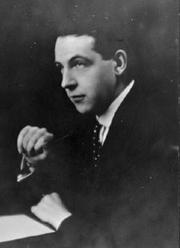
Claud Lovat Fraser
Claud Lovat Fraser (1890-1921) was an active artist in the fields of illustration and theater design. He was born in London on May 15, 1890 to Florence Margaret Fraser, an amateur artist, and Claud Fraser, a city solicitor. Fraser and his brother Alan were educated at various English boarding schools, including the prestigious Charterhouse School in Surrey, from which Fraser graduated in 1907. He then began a course of legal study, entered into articles of clerkship in his father's law firm, and joined a group of critics and artists who regularly congregated at Dan Rider's Den, a printer's shop. Fraser produced many caricatures of contemporary literary and theatric figures, and in 1910, he produced a privately printed edition of ten of these caricatures. In 1911, Fraser left his father's firm to seriously pursue art. He spent a brief period under the tutelage of Walter Sickert at Westminster Technical Institute. In 1912, Fraser executed decorations for Haldane Macfall's essay on art and aesthetics, The Splendid Wayfaring, and for Macfall's play The Three Students, considered but ultimately rejected for production by Herbert Beerbohm Tree. Fraser was also interested in producing affordable, quality toys, and some of his designs were executed. These and the illustrations for The Splendid Wayfaring and The Three Students were among the objects shown at his first solo exhibition, in his studio in February 1913. Fraser, Holbrook Jackson and the poet Ralph Hodgson established the "Sign of the Flying Fame" in 1913, and published several poetry broadsides and chapbooks illustrated by Fraser. Although printed in limited editions and often hand-colored, they were affordably priced and were intended to bring poetry to the general public. Flying Fame's activities ended with the start of World War I, replaced by Harold Munro's Poetry Bookshop. In the fall of 1914, despite a history of ill health, Fraser enlisted with the Inns of Court Officer Training Corps and was quickly commissioned to the 14th Battalion of the Durham Light Infantry. Fraser's war-era sketchbooks and the drawings he included in his correspondence provide an intimate visual record of the trenches and battlefields of Flanders in this early phase of the war. He was one of few British officers to survive the battle of Loos (September 25-October 8, 1915). In December 1915, Fraser's battalion was the first to withstand a German gas attack. In the excitement and confusion of the event, he neglected to put on his gas mask until he had emerged from his bunker and was dispatched to England for a short sick leave. Fraser was promoted to captain in January 1916, but by late February he was home on leave again, suffering from the effects of gas and shellshock after a battle at the Ypres Salient. While recovering, Fraser occupied himself with plans for a pictorial history of the Grenadier Guards that was never published. Successive Medical Board Reviews continued to find his health unfit for battle through the end of the war. Fraser instead served the Army as a clerk upon the completion of his sick leave in August 1916. He worked in the War Office on visual propaganda from October 1916 through late April 1917 and at the Army Record Office at Hounslow until his discharge in March 1919. In August 1916, Fraser met the American-born actress Grace Inez Crawford in the dressing room of a theater where she was appearing in Hugo Rumbold's L'Apres Midi d'un Faune. They were married on February 6, 1917 and had one daughter, Helen Catherine Adeline Lovat Fraser. His wife's theatrical interests may have contributed to Fraser's increased activities in stage and costume design after this date, and the two collaborated on many projects, including her translations of several eighteenth century Italian lyric plays. After the war, Fraser continued to make designs for the Poetry Bookshop, provided illustrations for approximately twenty books, executed private commissions for bookplates, stationery…
Books
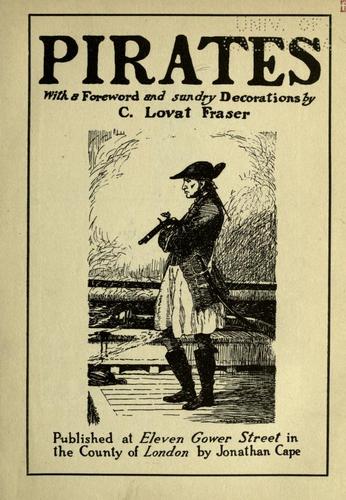
Pirates
1915
ISBN 9781472830487