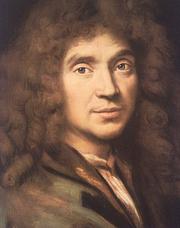
Molière
Molière (Jean-Baptiste Poquelin) was born in Paris on January 15, 1622. His father was one of eight valets de chambre tapissiers who tended the king's furniture and upholstery, so the young Poquelin received every advantage a boy could wish for. He was educated at the finest schools (the College de Clermont in Paris.) He had access to the king's court. But even as a child, Molière found it infinitely more pleasant to poke fun at the aristocracy than to associate with them. As a young boy, he learned that he could cause quite a stir by mimicking his mother's priest. His mother, a deeply religious woman, might have broken the young satirist of this habit had she not died before he was yet twelve-years-old. His father soon remarried, but in less than three years, this wife also passed away. At the age of fifteen, Jean-Baptiste was left alone with his father and was most likely apprenticed to his trade. The boy never showed much of an interest for the business of upholstering. Fortunately, his father's shop was located near two important theatrical sites: the Pont-Neuf and the Hôtel de Bourgogne. At the Pont-Neuf, comedians performed plays and farces in the street in order to sell patent medicines to the crowds. Although not traditional theatre in the strictest sense, the antics of these comic medicine-men brought a smile to Jean-Baptiste's face on many an afternoon. At the Hôtel de Bourgogne--which the boy attended with his grandfather--the King's Players performed more traditional romantic tragedies and broad farces. Apparently, these two theatrical venues had quite an impact on the young Poquelin, for in 1643, at the age of twenty-one, he decided to dedicate his life to the theatre. Jean-Baptiste had fallen in love with a beautiful red-headed actress named Madeleine Béjart. Along with Madeleine, her brother Joseph and sister Genevieve, and about a dozen other young well-to-do hopefuls, Jean-Baptiste founded a dramatic troupe called The Illustrious Theater. It was about this time that he changed his name to Molière, probably to spare his father the embarrassment of having an actor in the family. Molière and his companions made their dramatic debut in a converted tennis court. Although the company was brimming with enthusiasm, none of them had much experience and when they began to charge admission, the results proved disastrous. Over the course of the next two years, the little company appeared in three different theatres in various parts of Paris, and each time, they failed miserably. Several of the original members dropped out of the company during this period. Finally, the seven remaining actors decided to forget Paris and go on a tour of the provinces. For the next twelve years, they would travel from town to town, performing and honing their craft. It was during this period that Molière began to write plays for the company. His first important piece, L'Étourdi or The Blunderer, followed the escapades of Mascarille, a shrewd servant who sets about furthering his master's love affair with a young woman only to have his plans thwarted when the blundering lover inadvertantly interferes. The five-act piece proved quite successful, and a number of other works followed. By the spring of 1658, Molière and his much-improved company decided to try their luck once more in Paris. When they learned that the King's brother, the Duke of Anjou, was said to be interested in supporting a dramatic company which would bear his name, they immediately set about gaining an introduction to the Court. On the evening of October 24, 1658, Molière and his troupe performed for the first time before Louis XIV and his courtiers in the Guard Room of the old Louvre Palace. They made a crucial mistake, however, by performing a tragedy (Cornielle's second-rate Nicoméde) instead of one of their popular farces. The Court was not impressed. Fortunately Molière, realizing their blunder, approached the King at the conclusion of the tragedy and asked…
Books

The Complete Harvard Classics - ALL 71 Volumes
2024
ISBN 9782291090373
Tartuffe
1664
ISBN 9782038713152
Harvard Classics: All 71 Volumes
1722
ISBN 9782291093152
The Harvard Classics Shelf
2023

The Works of Moliere
2016
ISBN 9781357145033
DOM JUAN MOLIERE 2DE/1ERE N15
1665
ISBN 9782091872339
El avaro: de Molière
1668
ISBN 9788474909531
Moliere - The Learned Women: Les Femmes Savantes
1672
ISBN 9781787800922
L' Avare, de Molière
1668
ISBN 9789720405975
The Complete Harvard Classics - All 51 Volumes in One Edition
2019

The Greatest Works of French Literature
2020

Harvard's Classics Collection: Complete 71 Volumes
2023

Kibarlık Budalası
1670
ISBN 9786053328049
Eight Plays by Moliere
1950
ISBN 9780394309293
L'Ecole Des Femmes
1950
ISBN 9782011681171
The Harvard Classics Anthology
2023
Las preciosas ridículas / Las mujeres sabias
1659
ISBN 9788437613512
Le Bourgeois Gentilhomme
1670
ISBN 9782761651196
Molière : oeuvres complètes
1962
ISBN 9782080700414
Comedies of Moliere
2007
ISBN 9781434487544
Bibliolycée - L'Ecole des femmes, Molière: Parcours Comédie et satire
2019
ISBN 9782017064671
O avarento
2023
ISBN 9788596038140
El avaro / El enfermo imaginario
1668
ISBN 9788408174530
The School for Wives and The Learned Ladies, by Moliere
1991
ISBN 9780156795029