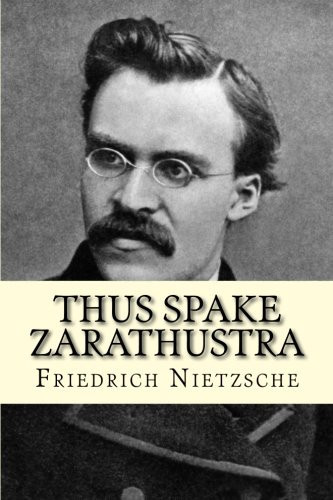
Thus Spoke Zarathustra: A Book for All and None also translated as Thus Spake Zarathustra is a philosophical novel by German philosopher Friedrich Nietzsche, composed in four parts between 1883 and 1885. Much of the work deals with ideas such as the "eternal recurrence of the same" and the parable on the "death of God"Thus Spoke Zarathustra was conceived while Nietzsche was writing The Gay Science; he made a small note, reading "6,000 feet beyond man and time," as evidence of this.[3] More specifically, this note related to the concept of the eternal recurrence, which is, by Nietzsche's admission, the central idea of Zarathustra; this idea occurred to him by a "pyramidal block of stone" on the shores of Lake Silvaplana in the Upper Engadine, a high alpine region whose valley floor is at 6,000 feet (1,800 m). Nietzsche planned to write the book in three parts over several years. He wrote that the ideas for Zarathustra first came to him while walking on two roads surrounding Rapallo, according to Elisabeth Förster-Nietzsche in the introduction of Thomas Common's early translation of the book.Although Part Three was originally planned to be the end of the book, and ends with a strong climax, Nietzsche subsequently decided to write an additional three parts; ultimately, however, he composed only the fourth part, which is viewed to constitute an intermezzo.Nietzsche commented in Ecce Homo that for the completion of each part: "Ten days sufficed; in no case, neither for the first nor for the third and last, did I require more" (trans. Kaufmann). The first three parts were first published separately, and were subsequently published in a single volume in 1887. The fourth part remained private after Nietzsche wrote it in 1885; a scant forty copies were all that were printed, apart from seven others that were distributed to Nietzsche's close friends. In March 1892, the four parts were finally reprinted as a single volume. Since then, the version most commonly produced has included all four parts.The original text contains a great deal of word-play. An example of this is the use of words beginning über ("over" or "above") and unter ("down" or "below"), often paired to emphasise the contrast, which is not always possible to bring out in translation, except by coinages. An example is Untergang, literally "down-going" but used in German to mean "setting" (as of the sun) but also "sinking", "demise", "downfall" or "doom"; which Nietzsche pairs with its opposite Übergang (meaning "transition", literally "over-going"). Another example is Übermensch (overman or superman), discussed later in this article.The book chronicles the fictitious travels and speeches of Zarathustra. Zarathustra's namesake was the founder of Zoroastrianism, usually known in English as Zoroaster. Nietzsche is clearly portraying a "new" or "different" Zarathustra, one who turns traditional morality on its head. He goes on to characterize "what the name of Zarathustra means in my mouth, the mouth of the first immoralist:"For what constitutes the tremendous historical uniqueness of that Persian is just the opposite of this. Zarathustra was the first to consider the fight of good and evil the very wheel in the machinery of things: the transposition of morality into the metaphysical realm, as a force, cause, and end in itself, is his work. [...] Zarathustra created this most calamitous error, morality; consequently, he must also be the first to recognize it. [...] His doctrine, and his alone, posits truthfulness as the highest virtue; this means the opposite of the cowardice of the "idealist" who flees from reality [...]-Am I understood?-The self-overcoming of morality, out of truthfulness; the self-overcoming of the moralist, into his opposite-into me-that is what the name of Zarathustra means in my mouth.
Rummaging the shelves…
Loading reviews…