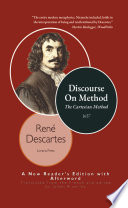
Discourse on the Method
2024·365 pages·en
Publisher, ISBN & more
- Publisher
- Minerva Press
- ISBN
- 9783989888753
"Descartes was the first to bring to light the idea of a transcendental science, which is to contain a system of knowledge of the conditions of possibility of all knowledge." - Kant A modern translation of Descartes' famous work "Discourse on Method". The full original title of this work was "Discourse on Method to lead one's reason well and to seek the truth in sciences plus Dioptric, Meteors and Geometry". This edition contains a timeline of Descartes' life and works, a glossary of Cartesian terminology, and Afterword by the translator that explains the significance of Descartes' contributions to modern philosophy and science, particularly his method of skepticism and rationalism. This scholarly apparatus nests this work into Descartes' larger body of work and the place of his philosophy into the broader history of western ideology. Descartes' focus on clear, logical reasoning is a hallmark of his philosophy, and his influence on fields such as mathematics and physics is profound, with his work laying the foundation for later scientific advances. René Descartes' Cartesian Method is of great historical importance because it laid the foundation for modern scientific and philosophical inquiry. Written in the early 17th century, these rules represent a turning point in Western thought, moving away from scholasticism, which relied heavily on Aristotelian traditions and church doctrines, and toward a method of inquiry based on reason and evidence. Descartes' approach emphasized systematic doubt and the use of methodical reasoning to uncover fundamental truths. This was revolutionary at a time when philosophical inquiry was often intertwined with religious and metaphysical assumptions. Written as an intellectual autobiography, the text charts his journey from skepticism to certainty through the development of a new philosophical method based on systematic doubt. Here Descartes first presents his famous cogito argument - "I think, therefore I am" - as an unshakeable foundation for knowledge, though in a less formal manner than his later Meditations. The work's accessibility masks its radical nature: by grounding certainty in individual reason rather than traditional authority, Descartes effectively undermines the entire edifice of medieval scholasticism while providing a new foundation for scientific knowledge. These rules were crucial to the development of the scientific method and influenced the way future generations of thinkers approached problems in both philosophy and science. By emphasizing clarity, order, and the use of simple, self-evident truths as the basis for more complex reasoning, Descartes provided a model for empirical investigation and rational inquiry that would later inform the work of thinkers such as Isaac Newton and Immanuel Kant. Moreover, the focus on doubt and questioning as a means of arriving at certainty set the stage for modern skepticism and analytic philosophy. Overall, Descartes' rules helped usher in the Age of Enlightenment by fostering a spirit of inquiry that challenged dogma and expanded the boundaries of human knowledge. The Discourse served as an introduction to three scientific essays (Dioptrics, Meteors, and Geometry), positioning itself as both philosophical manifesto and practical demonstration of his method. In describing how he arrived at his method, Descartes presents a carefully constructed narrative of intellectual development that simultaneously validates his approach while protecting himself from theological controversy. His four rules of method - accept only clear and distinct ideas, divide problems into manageable parts, proceed from simple to complex, and review thoroughly - appear deceptively simple but represent a fundamental shift in how knowledge could be pursued and validated. The work's influence extends far beyond philosophy, helping establish both the scientific method and the modern notion of the autonomous rational subject.
Rummaging the shelves…
Loading reviews…