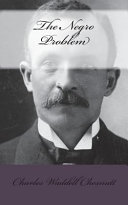
The Negro Problem
2018·66 pages·en
Publisher, ISBN & more
- Publisher
- Createspace Independent Publishing Platform
- ISBN
- 9781722615413
The Negro Problem By Charles Waddell Chesnutt Industrial Education for the Negro By BOOKER T. WASHINGTON, Principal of Tuskegee Institute The necessity for the race's learning the difference between being worked and working. He would not confine the Negro to industrial life, but believes that the very best service which any one can render to what is called the "higher education" is to teach the present generation to work and save. This will create the wealth from which alone can come leisure and the opportunity for higher education. One of the most fundamental and far-reaching deeds that has been accomplished during the last quarter of a century has been that by which the Negro has been helped to find himself and to learn the secrets of civilization-to learn that there are a few simple, cardinal principles upon which a race must start its upward course, unless it would fail, and its last estate be worse than its first. It has been necessary for the Negro to learn the difference between being worked and working-to learn that being worked meant degradation, while working means civilization; that all forms of labor are honorable, and all forms of idleness disgraceful. It has been necessary for him to learn that all races that have got upon their feet have done so largely by laying an economic foundation, and, in general, by beginning in a proper cultivation and ownership of the soil. Forty years ago my race emerged from slavery into freedom. If, in too many cases, the Negro race began development at the wrong end, it was largely because neither white nor black properly understood the case. Nor is it any wonder that this was so, for never before in the history of the world had just such a problem been presented as that of the two races at the coming of freedom in this country. For two hundred and fifty years, I believe the way for the redemption of the Negro was being prepared through industrial development. Through all those years the Southern white man did business with the Negro in a way that no one else has done business with him. In most cases if a Southern white man wanted a house built he consulted a Negro mechanic about the plan and about the actual building of the structure. If he wanted a suit of clothes made he went to a Negro tailor, and for shoes he went to a shoemaker of the same race. In a certain way every slave plantation in the South was an industrial school. On these plantations young colored men and women were constantly being trained not only as farmers but as carpenters, blacksmiths, wheelwrights, brick masons, engineers, cooks, laundresses, sewing women and housekeepers. We are delighted to publish this classic book as part of our extensive Classic Library collection. Many of the books in our collection have been out of print for decades, and therefore have not been accessible to the general public. The aim of our publishing program is to facilitate rapid access to this vast reservoir of literature, and our view is that this is a significant literary work, which deserves to be brought back into print after many decades. The contents of the vast majority of titles in the Classic Library have been scanned from the original works. To ensure a high quality product, each title has been meticulously hand curated by our staff. Our philosophy has been guided by a desire to provide the reader with a book that is as close as possible to ownership of the original work. We hope that you will enjoy this wonderful classic work, and that for you it becomes an enriching experience.
Rummaging the shelves…
Loading reviews…