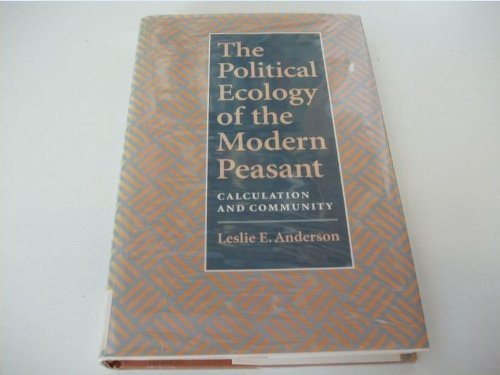
1994 · 208 pages
About this book
Does political action by peasants primarily serve the interests of the individual or does it address community concerns as well? Previous attempts to resolve this question often became mired in the age-old debate over selfish versus altruistic behavior. In The Political Ecology of the Modern Peasant Leslie Anderson goes beyond the polarized positions of previous discussions to reach a new synthesis in which individual and community interests are shown to be both interdependent and mutually sustaining. Anderson begins by demonstrating that peasant political behavior is far more complex than previously thought, ranging over a broad spectrum from the deliberate choice of quiescence to political violence or revolution. Between these two extremes, she examines the motivation underlying a variety of nonviolent collective actions. Her theory explains each of these forms of peasant action with reference to a particular world-view - the political ecological perspective - that peasants gain from living in a given social context that links the individual, the village, the natural environment, and society. Drawing on a wealth of personal experience in villages of Costa Rica and Nicaragua, Anderson puts forth a theory with broad implications for the study of peasant political behavior in Latin America and throughout the Third World. The Political Economy of the Modern Peasant will be of interest not only to political scientists but also to anthropologists, sociologists, and students of developing countries and Latin America.
Similar books
Rummaging the shelves…
Reviews
Loading reviews…