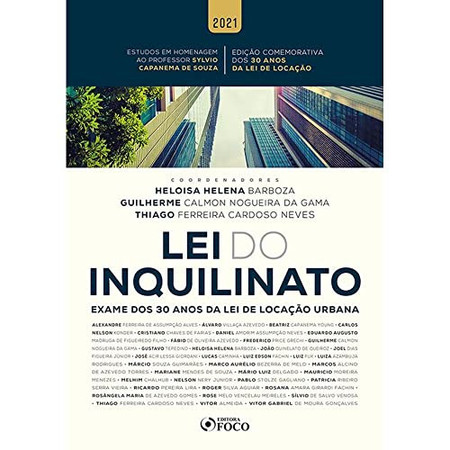
Lei do inquilinato
exame dos 30 anos da lei de locação urbana
by Heloisa Helena Barboza, Guilherme Calmon Nogueira da Gama, Thiago Ferreira Cardoso Neves, Heloisa Helena Barboza et al.
2021 · 507 pages
exame dos 30 anos da lei de locação urbana
by Heloisa Helena Barboza, Guilherme Calmon Nogueira da Gama, Thiago Ferreira Cardoso Neves, Heloisa Helena Barboza et al.
2021 · 507 pages
"This collective work is justified by a variety of reasons, though some deserve particular emphasis. Urban centers in Brazil bring together thousands of individuals and legal entities that qualify as lessors and lessees in countless situations—extending far beyond the simple dichotomy of residential versus non-residential urban property leases. Furthermore, due to numerous circumstances linked to the reality of social and economic exclusion, there exists a “parallel regime” governing the authorized use of certain properties within communities located in major urban hubs—a regime that operates outside the strict bounds of statutory law. Moreover, technology and human ingenuity have facilitated the expansion of the legal concept of property leasing into scenarios previously unforeseen by positive law—such as in cases involving properties offered under a sharing economy model, or even in cases of timesharing. All these facets entail substantive legal issues pertaining to urban property leasing. Yet, there are also significant procedural aspects within the legal framework governing the relationship between lessor and lessee across its various modalities. The procedural regime governing the diverse types of leases; the distinctive treatment accorded by Law No. 8.245/91 regarding procedural acts and applicable procedures; and the provision for highly specialized treatment concerning urgent relief measures in leasing disputes—these elements, among others, underscore the legislative intent to establish this statute as a veritable Charter for Urban Property Leasing. Accordingly, the book presented here to the reading public was conceived not merely as a compilation of disparate texts, but rather as a pioneering, systemic, and cohesive work examining the advancements and setbacks associated with the Urban Property Leasing Law. In a domain of such critical sensitivity to civil society and the market—and, naturally, to the State—Law No. 8.245/91 has demonstrated numerous merits, fostering greater stability and predictability within the urban leasing sector. As a product of the human spirit, it naturally contains imperfections—as does every human endeavor—yet it was conceived with the very best of intentions. One of the key figures in this narrative was Professor Sylvio Capanema de Souza, a man endowed with unparalleled sensitivity and erudition, and deeply versed in the intricacies of this specific legal field; in this way, he left his indelible mark upon the statutory text. Inspired by the figure honored in this volume, it is hoped that positive law will remain faithful to the underlying philosophy that gave rise to the enactment of Law No. 8.245/91—a philosophy born amidst the winds of the country’s redemocratization, the prioritization of national development (rather than mere GDP growth), the principles of inclusion and respect for the dignity of every human being, and the encouragement of free initiative and healthy, open competition within the corporate and economic spheres. In this manner, the law will continue to fulfill one of its most vital roles in human civilization: not merely serving as a pacifying force within society, but also facilitating the refinement of legal bonds and institutions so as to ensure a higher and better quality of life for individuals, while simultaneously fostering national development through the stimulation of private initiative and economic activity in general." -- Back cover.
Rummaging the shelves…
Loading reviews…