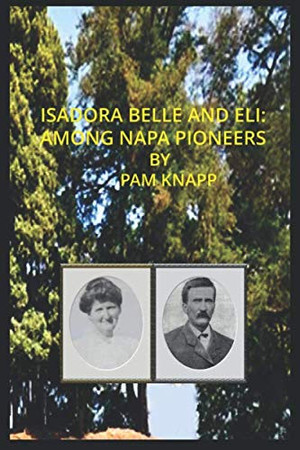
ISADORA BELLE AND ELI: AMONG NAPA PIONEERS boasts fast moving and easy-to-read prose, a sense of having lived vicariously through the period from 1850 to 1920, little known history of the late nineteenth and early twentieth centuries, everything the reader would ever want to know about the County of Napa in its early days, many surprise twists and turns for the main characters as well as laughter and sorrow, and extensive era historical documentation. This historical novel should invite the history buff, the casual history enthusiast, those who love reading California history, those who love historical novels, and those who want to know the trials and tribulations of this time frame without doing the research. Isadora and Eli are real people, who lived during that period and who convey the happenings of that time span through both actual events and their discussions of news stories. For instance, in the last chapters in the book, the Napa perspective of World War I is seen through Isadora's eyes when she reads the local headlines and sub-headlines, sees the recruitment of the troops, frolics in the celebrations at the Court House Square and on the streets of Napa for Fourth of July parades, perseveres with war rationing and as Napa is shut-down by the Spanish flu epidemic, experiences the homecoming of her boys and much, much more. The search for the history of Isadora Belle and Eli, my great- grandparents, began as a genealogical search and ended as an intense history of the era in which one or both lived: 1850 - 1920. The narrator begins the story by traveling to the Napa Valley, Sonoma, and the Hot Springs and describes both the history and geology as well as the wonders of the region. Characters are gradually introduced into the story along with dialogue. The latter is what turns a mostly non-fictional story into fiction. Isadora Belle and Eli is rich in the history of not only Eli's Civil War beginnings but also the book follows him to California in a stagecoach as he meets up with his relative Nancy Jane Harris - Stubblefield. The manuscript also enlists the Stubblefields as sub-characters and tells of their plight from Napa to La Graciosa in a covered wagon per the citing of actual records. Then after the burning down of La Graciosa via the railroad baron Henry Mayo Newhall, Eli leaves La Graciosa and lives in Napa County where he meets the Waddells and, of course, Isadora Belle whom he courts and weds. Shortly after marriage, Eli decides to take his pregnant bride to Oroville where their first child Thomas is born. He does not get rich panning for gold; so, Eli takes a job as a teamster. Isadora is unhappy with the living conditions, and the baby is fussy with the heat and mosquitoes; therefore, they return to Napa where they meet up with a group going to Tulare County to help with the harvest as Isadora feels farming is a noble occupation. They stay there but a short time before going to Bakersfield and then back to La Graciosa, which is later called Santa Maria. During this period, Eli jokes about their life style as being akin to gypsies. After the birth of another child, they return to Napa County where they have four more children. The history of Napa, thus, is covered from 1882 to 1920, and the book ends when Isadora dies. Again, much of the history of the Harris family and Napa is seen through Isadora's eyes and what she reads in the newspaper - the presidents of the time, the politics of the day, the economy, the parties and events, the war years of World War I, the happenings in Europe and at home, soldiers Robert and Leonard in France, and then Robert Elmer Harris' meeting of Agnes Kiser and later marriage to her. It is my hope that the reader will be amazed at all the history that he/she never knew about that transpired in the period from 1850 to 1920. This book should be "G" Rated and neither geared more to men or women.
Rummaging the shelves…
Loading reviews…